


Build a focused wallet analytics API use case with wallet behavior intelligence from Bluwhale. Connect onchain activity and permissioned user context to the content, recommendations and agent behavior your product delivers. Bluwhale’s shared intelligence layer brings identity, behavior and interactions together, giving applications a way to use financial context in the experience they build. Start with one product decision: which information should this screen prioritize for the user? Then connect the activity relevant to that decision with a clear explanation of how it informs the experience. The focus is a more purposeful application, with wallet activity serving the user’s task.
Discuss this data use case with Bluwhale
Describe the application screen, activity scope and user experience your wallet analytics API should support. Bluwhale’s contact form opens a discussion about data access and the integration for that use case.
Give your wallet analytics API a clear application task
An application can use onchain activity signals to decide which information deserves attention. Protocol interactions, token movements and the period under review can each contribute to that context. The product task is to turn the relevant observations into a useful experience, such as the order of educational modules or the focus of an agent’s explanation.
For a wallet analytics API use case, Bluwhale organizes behavior and interactions in a shared intelligence layer. Applications can use the resulting context to personalize an experience around the user. For your team, the useful question is concrete: what will change on the screen when a relevant activity pattern is present?
Keep that decision visible in the use case. It connects the intelligence your application consumes with the product experience you intend to deliver.
From an observation to a useful signal
An observation describes activity. An interpretation identifies a pattern relevant to your app. A product decision determines what the interface does with the interpretation supplied through a wallet analytics API. Keeping these roles clear makes the use case easier to explain to both the product and engineering teams.
For example, repeated interaction with a protocol is an activity pattern. Your application may use it to prioritize information about that protocol’s mechanics. The pattern and the choice of content remain distinct: one describes the activity, while the other belongs to your product design.
Bluwhale’s architecture connects activity with structured user context, user embeddings and AI inference. Use that capability to shape a defined experience, with the observation and its purpose kept understandable in the integration brief.
One application screen, two activity patterns
Consider a conceptual wallet analytics API example: the same app screen has two educational modules, one about a protocol and one about reviewing token transfers. Wallet A shows a pattern of protocol interaction during the selected period. Wallet B shows token-transfer activity during that period. The application can place the more relevant module first for each pattern.
The screen keeps its core function while the information order changes. Wallet A’s view leads with the protocol explanation; Wallet B’s view leads with the transfer-review module. This is a design example of activity-informed relevance, with the product team choosing what each module is there to help the user understand.
Bluwhale provides the user-intelligence proposition for wallet-based application personalization. Your team defines the screen, relevant activity and decision it wants the app to make. The result is a focused wallet analytics API use case, with a clear relationship between the signal and its role in the experience.
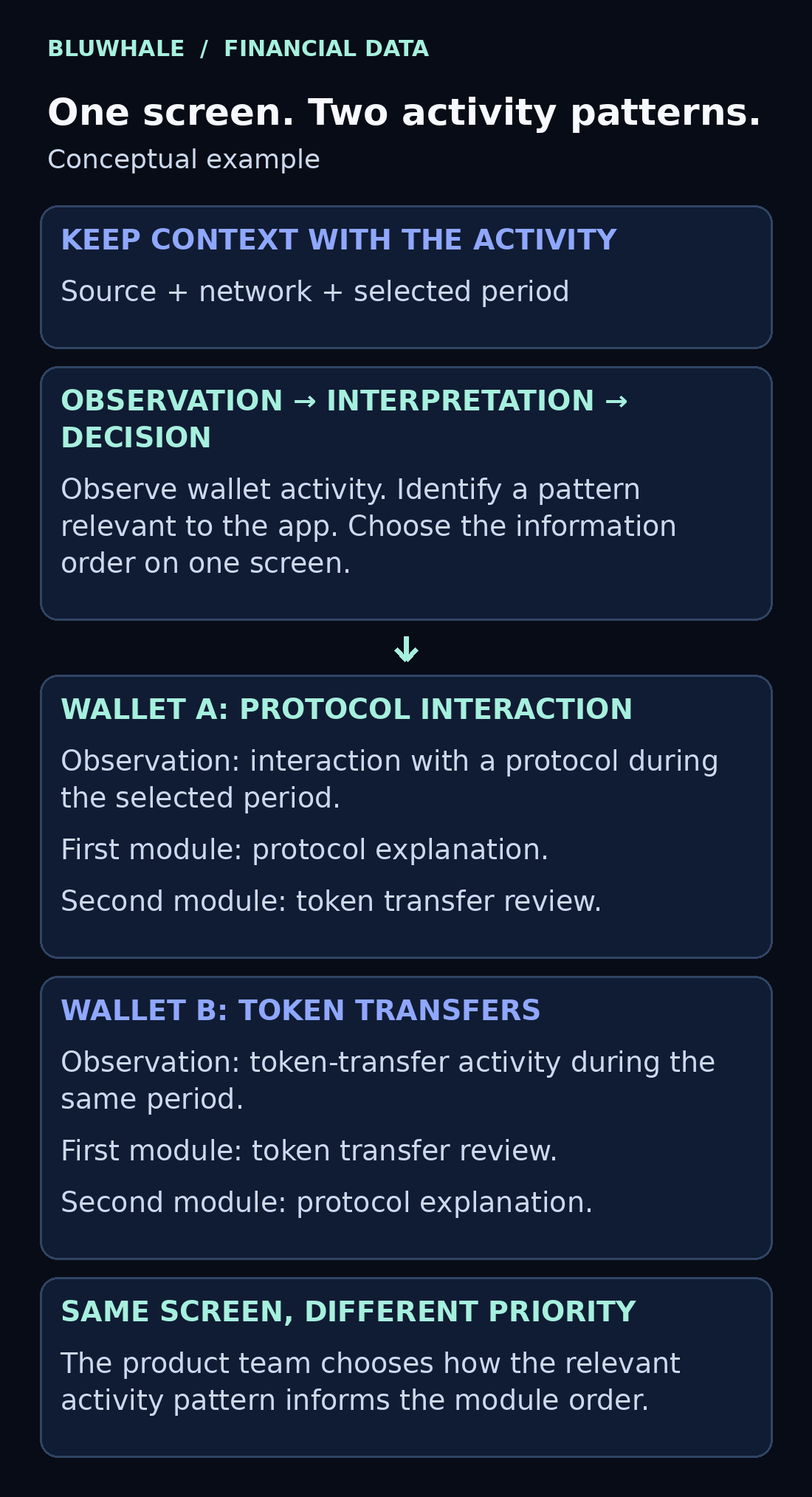
Keep source, network and time window with the signal
Activity has a location and a time. Keep the network, source and selected observation period with the signal your wallet analytics API will use. That context makes it easier to describe why the pattern is relevant to this screen and when it should inform the experience.
A period-specific observation has a different purpose from an account balance or an enduring user preference. Define the role you want it to play in the product. This helps your application use the signal in a way that matches the task, with user permissions aligned to the experience.
Analytics for applications and portfolio tracking serve different tasks
A personal wallet tracker helps a user review holdings at an address. Wallet behavior analytics for an application serves a different buyer and output: the product team consumes activity context to inform a feature. Keep that distinction clear when describing the integration you want to build.
Nansen’s published cross-chain wallet case illustrates the wider category: an application team uses an analytics API for wallet and token research and partner-facing features. For your wallet analytics API, focus on activity-informed relevance in the application, connected to Bluwhale’s shared intelligence layer.
Scope the experience with Bluwhale
Bring a specific wallet analytics API use case to Bluwhale: the screen you are building, the activity period, relevant networks and the information your product should prioritize. Describe how the user chooses the context used for that experience. That gives the data discussion a clear product purpose.
Explore the Bluwhale Financial Data API for the wider offering. Continue with financial user embeddings to understand how activity patterns can be represented for personalization. Start with one screen and one useful decision, then discuss the data and integration around it with Bluwhale.
Discuss this data use case with Bluwhale
Wallet behavior analytics questions
How does a wallet analytics API differ from a consumer wallet tracker?
A consumer wallet tracker helps someone review holdings, while a wallet analytics API serves an application team using activity context to shape a product experience. Bluwhale connects financial data with a shared intelligence layer for applications and AI agents. Define the screen or response you want to personalize, then use the relevant wallet behavior to explain which information should receive attention in that experience.
Does related activity prove two wallets share an owner?
Related activity describes an observed pattern, rather than establishing common ownership. In a wallet analytics API project with Bluwhale, keep the application’s decision tied to the activity signal it actually uses, such as protocol interaction or token-transfer history. This makes the product explanation clearer and preserves the distinction between a useful behavioral relationship and a separate claim about a person’s identity.
How do I start a wallet analytics integration discussion with Bluwhale?
Start with Bluwhale’s contact form and describe the application, screen, activity scope and user experience you want to build. For a wallet analytics API, identify the period, relevant networks and the information the product should prioritize. Bluwhale’s Financial Data API combines permissioned financial context with user intelligence, giving the conversation a product foundation for content relevance, recommendations or personalized agent responses.
Which wallet activity signals should the application use?
Choose signals that explain the product decision your wallet analytics API is meant to support. The article’s conceptual example uses protocol interactions and token transfers to prioritize different educational modules. With Bluwhale, connect those selected observations with the user-intelligence layer and the experience your application delivers. Keeping network, source and observation period with the signal makes the intended personalization easier to explain.
How can wallet activity inform an application’s content priorities?
Connect the observation, relevant pattern and interface decision in the wallet analytics API brief. For example, repeated protocol interaction may make a protocol explanation more relevant on the selected screen. Bluwhale’s shared intelligence layer relates identity, behavior and interactions, with embeddings and AI inference supporting personalized content and agent responses. Your team defines how that context changes the specific experience users receive.
How does Bluwhale connect wallet analytics with wider financial context?
Bluwhale’s Financial Data API combines permissioned financial profiles with a shared intelligence layer, so wallet activity can contribute to an application’s broader understanding of user context. The published offering includes financial information across wallets, banks, cards and exchanges, alongside graph relationships, embeddings and AI-generated insights. Choose the context relevant to the product task and explain how it supports a more useful application or agent experience.