


Make your agent more relevant with financial user embeddings from Bluwhale. The same request can mean different things for different users: the accounts they use, the activity they have authorized and the financial task they want to complete all shape what a useful response looks like. Bluwhale turns user context into a representation that supports personalized experiences across applications and agents. For product teams, the opportunity is practical: deliver an explanation, recommendation or follow-up that fits the person using the experience.
Discuss this data use case with Bluwhale
Describe the agent you are building and how financial user embeddings should personalize its user experience. The Bluwhale team can discuss the financial context and integration requirements for that use case.
What financial user embeddings represent
Financial user embeddings represent relevant patterns in user context. Bluwhale’s intelligence layer brings together identity, activity and interactions, then uses embeddings and AI inference to support application intelligence. That representation helps an experience use context across sources instead of treating each activity item as an isolated event.
For teams building user embeddings for financial agents, the product question is what that context should help the agent do. A monthly review may need a useful order for its summary. An onboarding flow may need a relevant next topic. A follow-up may need to stay connected to the user’s recent task. Embeddings support that personalization role within Bluwhale’s shared intelligence layer, connecting user patterns with an application experience.
One task, two relevant experiences
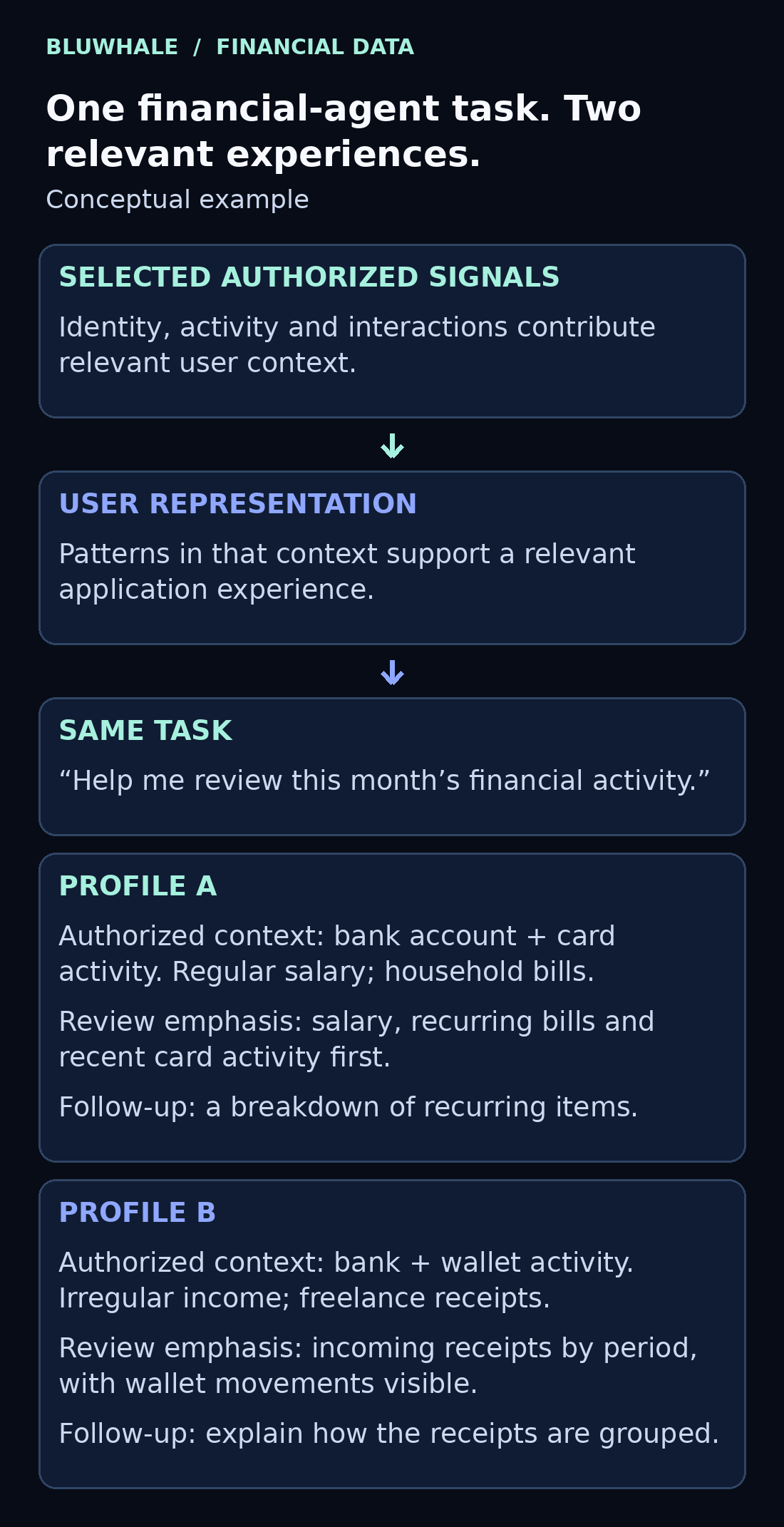
Consider this conceptual example of financial user embeddings. Two users ask the same agent: “Help me review this month’s financial activity.” Profile A has authorized a bank account and card activity, shows regular salary income and uses the application to review household bills. Profile B has authorized bank and wallet activity, shows income arriving at irregular intervals and uses the application to organize freelance receipts. Those are explicit inputs to the example.
For Profile A, a relevant review could place salary, recurring bills and recent card activity first. Its follow-up could offer a clearer breakdown of the recurring items. For Profile B, the same task could organize incoming receipts by period and keep wallet movements visible alongside bank activity. Its follow-up could help explain how those receipts are grouped. Financial user embeddings help both experiences serve the same task while emphasizing context that matters to the selected profile.
The product value is easy to assess: users should recognize why the summary is relevant to their request. Each difference in the example follows a stated signal and a stated task. The experience remains a financial review, with a clearer order and a more useful next interaction. With Bluwhale, financial user embeddings provide a foundation for designing that kind of relevance into your agents.
Give personalization a clear product job
Choose one interaction where financial user embeddings can make contextual agent responses more useful. Define the request, the response element you want to personalize and the signals that explain the difference. For a summary, that element might be the order of topics. For a follow-up, it might be the account or activity category the agent expands. A clear product job makes the use case easier to design and discuss.
Then connect the personalized element with a practical outcome. Did the user find the activity they wanted to understand? Was the next question relevant to the task? Could they complete the review with less repetition? These are useful criteria for evaluating your own application experience. They give the team a focused way to judge relevance while building around the capabilities Bluwhale describes.
Keep profiles, graphs and embeddings distinct
The three concepts have different jobs. A financial profile organizes user records and financial context. A financial knowledge graph describes relationships between identities, behavior and interactions. Financial user embeddings represent patterns that support personalization. Together they contribute to Bluwhale’s shared intelligence layer, while this use case concentrates on representation and the experience it helps shape.
Explore the financial knowledge graph when your next question concerns relationships across sources. For the broader developer offering, the Bluwhale Financial Data API connects financial data with user intelligence for applications and agents. Keeping those roles clear helps your team focus the integration discussion on the product outcome you need.
Scope your data use case with Bluwhale
Bring a specific financial personalization use case to Bluwhale: the application, the user task, the authorized signals and the experience you want to make more relevant. Bluwhale describes portable, composable user embeddings that users can opt in to share with dApps. That user participation is part of the product context as you define how your application will use the representation.
Start your financial user embeddings use case with the interaction that matters most. Explain what stays common for every user and which element should respond to context. From a focused monthly review to a relevant agent follow-up, a concrete example makes the data discussion productive. Contact Bluwhale to discuss the application experience and the financial intelligence it needs.
Discuss this data use case with Bluwhale
User embedding questions
How do financial user embeddings differ from a financial profile?
A financial profile organizes selected user and account records, while financial user embeddings represent patterns relevant to personalization. Bluwhale combines these complementary components in its shared intelligence layer for applications and AI agents. Start with the experience you want the agent to deliver, then distinguish the financial context it needs from the representation that helps make its response more relevant to the user.
How should our team evaluate financial personalization with Bluwhale?
Choose a task-specific product criterion for the experience your financial user embeddings should improve. With Bluwhale, that might mean a monthly summary leads with the activity the user wants to understand, or a follow-up stays connected to the selected account. Compare the experience around that criterion and document the result in your application. This keeps personalization tied to a recognizable user benefit.
How do we discuss user embeddings for financial agents with Bluwhale?
Use Bluwhale’s contact form to describe the application, intended interaction, authorized context and output you want to personalize. For financial user embeddings, explain which part of an agent response should change with user context, such as topic order or a relevant follow-up. The Financial Data API discussion can then connect your product goal with the financial data, user intelligence and integration requirements behind the experience.
How do financial user embeddings shape contextual agent responses?
Bluwhale represents relevant user patterns through embeddings and combines that context with AI inference for application intelligence. A financial review can therefore be designed around the user’s selected activity instead of giving every person the same emphasis. In this article’s conceptual example, the same monthly-review task prioritizes different account activity for two profiles, with the product team defining which response elements should reflect that context.
What inputs should define a financial user embeddings project?
Define the user task, authorized financial context and response element your financial user embeddings should help personalize. In Bluwhale, connect that product brief with the sources and user-intelligence components relevant to the experience. For a monthly review, specify whether the useful difference concerns topic order, selected accounts or a follow-up question. Clear inputs make the intended benefit easier for product and integration teams to discuss.
How do user permissions fit personalized financial agents?
Bluwhale builds financial-data experiences around user-permissioned context and describes user representations that can support personalized applications. Keep the selected data and the agent’s purpose aligned with the scope the user chooses to share. This gives personalization a clear product basis: use relevant patterns to shape the requested explanation, recommendation or follow-up while keeping the experience centered on the financial task the user wants to complete.