

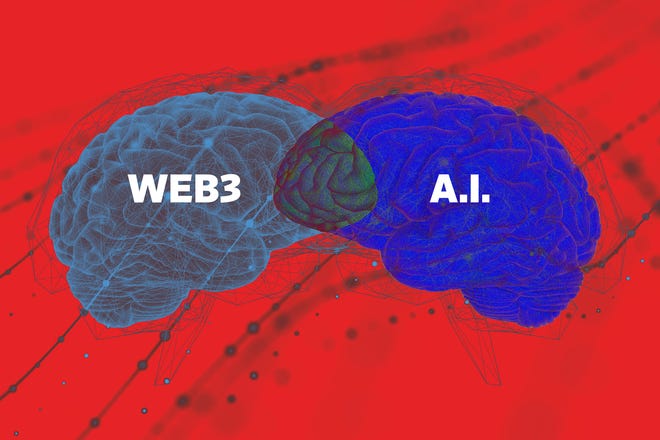
A decentralized AI agent does not necessarily mean the model itself runs on a blockchain. In practice, Web3 can decentralize specific layers around an agent: identity, reputation, validation evidence, wallets, permissions, payments and public audit trails. The model may still run off-chain, call centralized APIs or rely on proprietary data. The useful question is therefore: which layer is decentralized, what trust assumption does that remove, and what new risk does it introduce?
What is a decentralized AI agent?
An AI agent is software that can interpret a goal, use tools, interact with data and potentially take actions. A decentralized AI agent adds blockchain or other Web3 infrastructure to one or more parts of that workflow.
The important distinction is architectural. The reasoning model can remain off-chain while the agent uses an on-chain identity, a smart-account wallet, a reputation registry or machine-native payments. That is a hybrid design, not a fully on-chain AI.
Ethereum's 2026 AI-agent guidance reflects this layered reality: agents may control wallets, make payments and use smart-contract guardrails while model inference still happens elsewhere.
Which parts can actually live on-chain?
This is why 'the AI lives on-chain' is usually the wrong shorthand. Most practical systems are hybrid: computation remains off-chain, while economic, identity or control layers use blockchain infrastructure where public verifiability or programmable ownership is useful.
Identity and discovery: how agents can find each other
Cross-organizational agents need a way to identify one another without relying on a single private directory. ERC-8004 proposes an on-chain identity registry where an agent can have a persistent identifier and registration metadata.
That can make identity portable across organizations and applications. It can also give other services a common reference point for reputation or validation records.
But registration proves only that a record exists. It does not prove that the agent is competent, honest, secure or even functional. ERC-8004's own security considerations explicitly reject that stronger interpretation.
Reputation is public evidence—not guaranteed trust
A reputation registry can make feedback about an agent more portable and inspectable. That is useful when multiple organizations want to share signals about prior interactions.
The hard part is the quality of the feedback. Open reputation systems can be manipulated through Sybil identities, collusion, incentive farming or low-quality reviewers. A public score is therefore evidence about prior reports, not objective proof that the agent is safe.
A practical design may combine on-chain feedback with curated or off-chain aggregation, weighting reviewer quality, interaction context and fraud controls rather than treating every review as equal.
Validation: what can actually be checked?
Verification narrows a trust assumption; it does not eliminate every other one. A proof can show that a specific computation was performed correctly while saying nothing about whether the input data was true, the objective was appropriate or the resulting action was suitable.
Wallets, permissions and machine-native payments
Economic agency becomes more concrete when an agent can hold or control a wallet. That makes permission design more important than the slogan of autonomy.
ERC-4337 smart accounts make account validation programmable. At the application or wallet layer, this can support bounded authority such as approved assets, whitelisted destinations, spending limits, session limits or escalation rules.
x402 provides a different piece of the stack: programmatic stablecoin payments over HTTP, allowing machine clients—including AI agents—to pay for APIs or services without a conventional checkout flow.
The design principle is bounded economic agency. Payment capability is not a reason to remove budgets, logs, policy controls or user review for consequential actions.
What Web3 does not magically fix
Prompt injection or malicious instructions entering the workflow.
A bad model objective, hallucination or incorrect reasoning.
False or manipulated off-chain data or oracle inputs.
Poor wallet policy or overly broad permissions.
Smart-contract bugs, bridge/oracle dependencies and transaction-cost or finality trade-offs.
Sybil or manipulated reputation systems.
Privacy leakage from putting sensitive metadata or behavior on public ledgers.
Governance capture or privileged-key risk in surrounding protocols.
Suitability, financial-advice or legal/compliance obligations.
Blockchain immutability preserves records; it does not make every recorded claim true. If an oracle submits bad data, a model produces a bad recommendation or an agent owner publishes misleading metadata, the chain can preserve that mistake perfectly.
Centralized vs. decentralized vs. hybrid agent architecture
For many real products, hybrid is the practical default. Centralized compute can preserve speed and privacy, while on-chain identity, permissions, settlement or proofs can add portability and auditability where those properties justify their cost.
What this means for Bluwhale
The standards discussed above describe approaches within the wider Web3 ecosystem. Each implementation combines them differently according to its purpose and design.
Bluwhale applies AI to connected financial context across traditional and digital assets. This gives readers a practical connection between the wider Web3 infrastructure discussion and the everyday challenge of understanding fragmented financial information.
Explore Bluwhale's company and ecosystem pages to learn how that approach is developing across its products and network.
The right question is: which layer is decentralized?
“Decentralized AI” is too broad to be useful on its own. An agent can be decentralized in one layer and centralized in another. Identity may be portable while compute remains proprietary. Payments may settle on-chain while the model relies on a private API. Validation may be public while the underlying data remains off-chain.
A trustworthy architecture discussion names the layer, the trust assumption it removes, and the new trade-off it introduces. That is a stronger foundation than treating blockchain as a guarantee that an AI system is automatically true, safe or autonomous.