


Prepare a clear financial agent offer for users with Bluwhale. Describe the job, its sources and the result, then bring that offer into the Bluprint publishing flow. For creators researching Masumi AI agents, the comparison with Bluwhale centers on the responsibilities around the service: agent identity, payments, discovery and delivery. Bluwhale centers this route on publishing a financial agent for users. Masumi provides identity and payment infrastructure for agentic services, with both self-managed and hosted options. Your choice depends on the product experience you want to offer and the operating role your team wants to take.
Prepare my financial agent listing
Open Bluprint and prepare the financial task, intended user and expected output. Give the agent an introduction that makes the offer clear to someone browsing for that job.
Bring a focused financial offer to users
Consider Masumi AI agents through a financial-service example: an agent that returns a concise financial summary from selected sources. Its user wants an understandable report with a clear subject, inputs and format. A useful listing tells that user what the agent covers and what they receive from the service.
Bluwhale’s publishing route gives that offer a financial-agent setting. Prepare the name, profile image and introduction, then use the subscription setting and receive-wallet fields in Bluprint. The commercial focus stays on a defined task and the experience people choose when they open the agent.
A Bluwhale vs Masumi comparison starts with the value of a specific offer: the buyer can understand the work before deciding whether it fits their needs.
Identity and Payments for Masumi AI Agents
Masumi AI agents use a framework-agnostic protocol for agent identity and payments. Its Registry Service supports querying registered agents, while the Payment Service handles the transaction-related side of the network. Those services address different parts of operating an agent business.
Masumi agent identity helps a creator establish which registered service is being offered. Masumi payments support the commercial exchange around that service. The agent still needs a clear task, a way to receive the required input and an output that makes sense to the buyer. Keep those service details with the infrastructure decision.
A practical comparison for Masumi AI agents starts with what the financial agent does, then considers how identity, commercial access and delivery fit the product.
Choose between self-managed and hosted Masumi routes
For Masumi AI agents, a self-managed node route gives teams control over their Payment Service and infrastructure. Masumi also provides Masumi as a Service, a hosted application for agent registration, verification and management, with managed integration to payment and registry services.
The hosted route changes who operates the Masumi service layer. It does not make self-hosting a universal requirement for builders. Keep that choice separate from the agent’s own work: the financial task, how it receives inputs and where its result is delivered remain part of the service design.
When comparing Masumi AI agents with Bluwhale, decide how much of the network-service operation your team wants to manage, together with the publishing and user experience it intends to offer.
Compare the responsibilities around the offer
| Responsibility | Bluwhale publishing route | Masumi routes |
|---|---|---|
| Agent identity | Prepare name, image and introduction in Bluprint. | Register the agent identity through the Masumi network. |
| Payment setup | Listing includes monthly subscription and receive-wallet settings. | Payment Service handles the network’s transaction role, through self-managed or hosted access. |
| Operating choice | Create and prepare the offer within the Bluprint publishing route. | Choose a self-managed node or hosted Masumi service layer. |
| Discovery | Financial-agent discovery through the Bluwhale Agent Store. | Sokosumi provides a marketplace route after Masumi registration. |
| Financial task | State sources, inputs and the output the user receives. | Define the agentic service and its input/output interface. |
| User support | Use the introduction and optional public links to explain the offer. | Keep service documentation and support connected to the registered offer. |
Use the matrix to evaluate Masumi AI agents around the service you intend to sell. The operating model and the buyer’s experience belong in the same decision, with each responsibility attached to a clear part of the product.
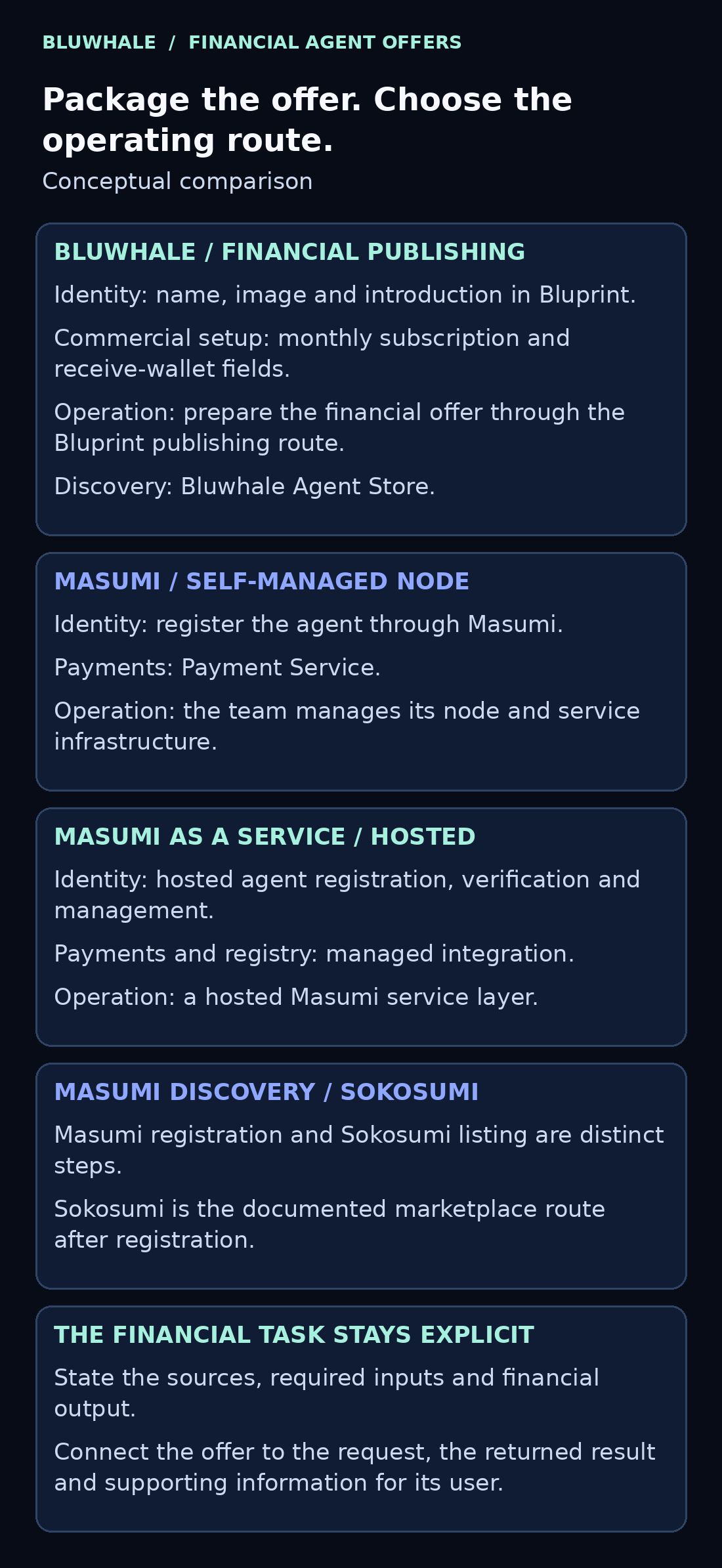
Follow one financial service from request to result
For Masumi AI agents serving the financial-summary example, begin with the buyer’s request and the information the agent needs. Describe the format of the returned summary and the scope it covers. Those choices make the service understandable regardless of the infrastructure around it.
In Bluwhale, use that description in the Agent Introduction and prepare the financial offer within Bluprint. In a Masumi-based service, connect the task to its registered identity and chosen payment-services route. For marketplace discovery, include a Sokosumi agent listing after network registration. Masumi documents listing an agent on Sokosumi as the route for that step.
For Masumi AI agents and Bluwhale listings alike, keep the buyer’s result central. A well-described service explains what the person receives and where to find supporting information, while the operational route defines how your team provides that experience.
Prepare the Bluwhale listing around your financial task
Make the name and introduction specific to the job. Bring the profile image, monthly subscription setting and intended receive wallet into the publishing flow. Go Live opens Publish Agent in Bluprint, giving these details a clear place in the financial listing.
Explore how to publish a financial agent on Bluwhale for the broader route. If your next comparison concerns commercial access models, continue with the Nevermined monetization comparison. Keep this decision focused on the service, its operating responsibilities and the experience users receive.
Prepare my financial agent listing
Bluwhale and Masumi questions
Do I need to operate every Masumi service myself?
No. For Masumi AI agents, Masumi as a Service provides a hosted route with managed payment and registry integration. A self-managed node remains available for teams that want control over those operational components. Bluwhale’s comparison centers on the financial-agent offer and its user journey, so assess the operating model alongside the publishing, discovery and delivery experience your team intends to provide.
Is Masumi registration the same as a Sokosumi listing?
They are distinct steps. For Masumi AI agents, network registration establishes the agent identity and service context; the documented Sokosumi listing route supports marketplace discovery after registration. Bluwhale’s Agent Store similarly makes discovery part of a broader financial-agent ecosystem. In either comparison, explain the service’s financial task and output so the person discovering it understands the reason to choose it.
How should Masumi AI agents and Bluwhale listings explain payment and delivery?
A useful offer states the financial task, how the user accesses it and what result they receive. In Bluwhale, the Publish Agent form places the introduction alongside the monthly subscription setting and receive wallet. Masumi’s identity and payment infrastructure addresses a different part of operating the service. Keep the user’s expected result and each operating responsibility explicit when packaging the offer.
How do I turn a financial-summary task into a Bluwhale offer?
Start with the intended reader, the information the agent uses and the format of the returned summary. In Bluwhale, put those details in the Agent Introduction and give the agent a name and image that make the job recognizable. The Bluprint publishing workflow organizes those identity fields with the commercial settings, connecting a defined financial service with its prospective users. Compare Masumi AI agents with that clear offer, using the task and expected result as the common reference.
What commercial information belongs in Bluwhale Bluprint’s Publish Agent form?
Prepare the monthly USD Subscription Fee and Receive Wallet alongside the profile image, agent name and introduction. Bluprint’s documented form also includes optional social and website links. Bluwhale’s developer offering connects financial-agent development with monetization through subscriptions, performance fees and BLUAI token rewards. The listing itself should present the financial task and output in terms its intended users recognize.
How does Bluwhale connect financial-agent creation with discovery?
Bluwhale brings financial-agent creation, publishing and discovery into one ecosystem. Bluprint supports the creation and listing preparation routes, while the Agent Store helps people discover specialized financial agents. A creator can describe the task, sources and response in the introduction, giving the agent a clear product identity and connecting the service with the financial question it is designed to help users explore.