


Build a focused financial research agent with Bluwhale Bluprint. If you are considering a Dify alternative for a crypto or financial-research task, Bluprint gives you a direct route from natural-language instructions to an agent you can use on demand. Define the topic, select public sources and specify the brief you want to receive. The result fits inside Bluwhale’s wider financial-agent experience, keeping the creation task close to the way the agent will be used.
A Bluwhale vs Dify comparison should begin with the experience you want to deliver. Assess a Dify alternative against the user’s need for a concise summary of official project updates, a focused research brief or an explanation of financial information. That objective gives the platform choice a practical basis: the control you need over the application and the financial workflow your user wants to use.
Choose a Dify Alternative Around the Financial Task
Dify provides a broad platform for building and managing AI applications. Its offering includes Workflow Studio, Knowledge Pipeline and a marketplace for tools, models and integrations. It supports creating agents by chatting as well as by configuring them manually. Dify also presents financial-services use cases, making it relevant to teams that want to design a financial application around its configurable components.
As a Dify alternative for financial AI agents, Bluprint focuses on creating a research agent within Bluwhale. The public creation workflow uses natural-language instructions, public sources and an on-demand brief. This suits a creator whose immediate objective is a useful financial research experience. A team whose central requirement is model selection, workflow design and deployment architecture has a different application-building job to solve.
Dify and Bluprint by task
| Decision area | Dify | Bluwhale Bluprint |
|---|---|---|
| Creation approach | Create by chat or configure the agent and workflow | Define a focused research task with natural-language instructions |
| Knowledge and tools | Knowledge Pipeline and reusable tools or integrations | Choose public research sources and the brief the agent should produce |
| Application control | Design workflows, app behavior and deployment | Create and use the agent within the Bluwhale experience |
| User delivery | Publish as an app, API or other supported access point | Open the saved agent for an on-demand research request |
| Broader product route | Managed cloud and self-hosted deployment options | Financial-agent ecosystem, developer resources and distribution paths |
The Dify vs Bluprint table is most useful when you read it around your actual requirement. The relevant question for a Dify alternative is what you need to deliver and maintain. A configurable application may need several knowledge sources, tool connections and an application-specific interface. A financial research agent may need a precise brief, selected sources and a useful answer for the person using it. Bluprint is a direct fit for that focused creation-and-use workflow.
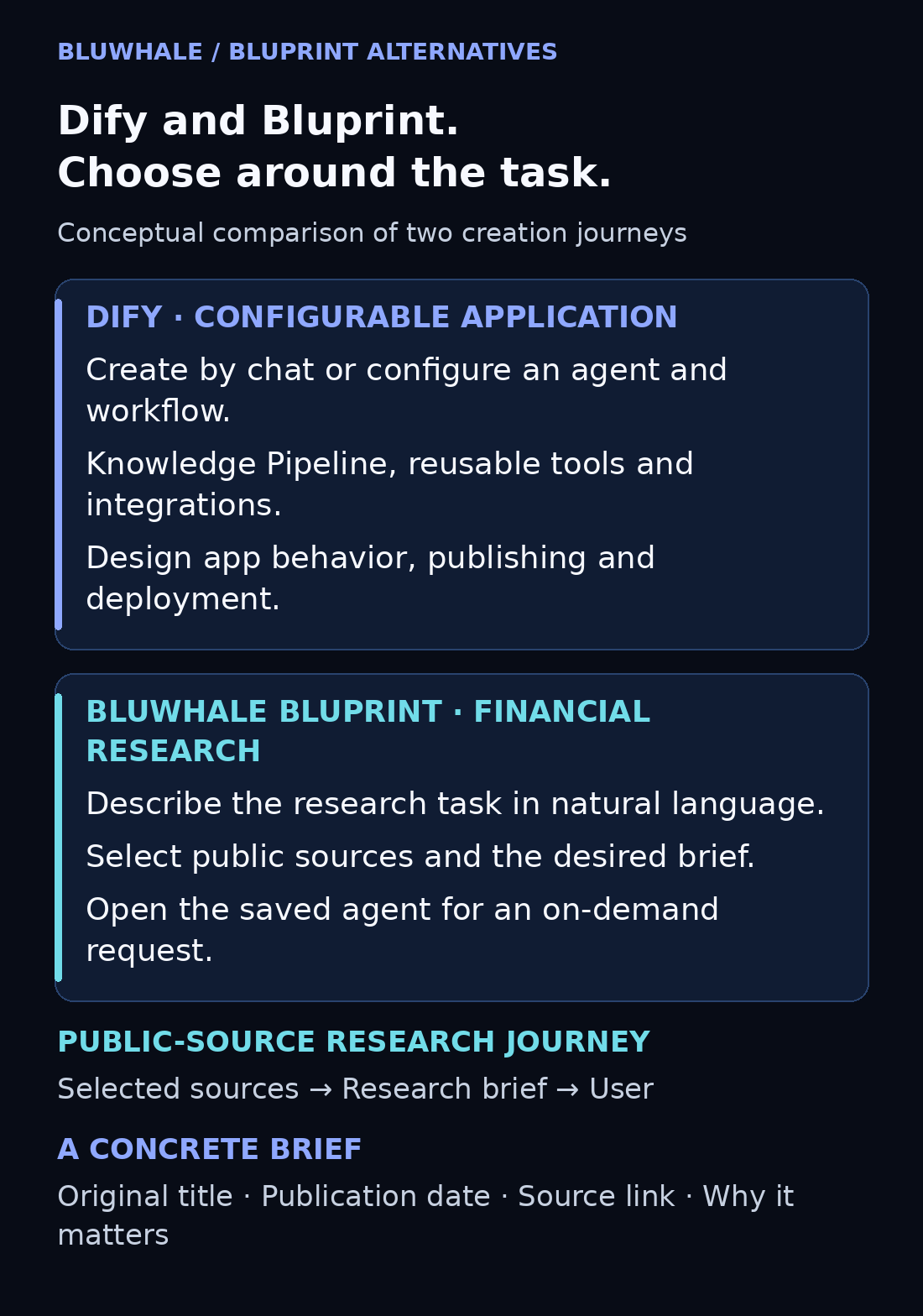
Make the financial brief concrete
To evaluate a Dify alternative, consider a research brief about two official Bitcoin or Ethereum updates. Specify the sources the agent should use and ask for the original title, publication date, source link and a short explanation of why each update matters to the research topic. This gives the agent a recognizable financial-research job and gives the user a compact output to read and explore.

In Bluprint, use those requirements as the instructions for the agent. You can tailor the topic, response language and format around your own research purpose. A concise brief makes the financial value clear: relevant updates, their source context and the next subject worth examining. It also keeps the agent’s role understandable when you return to use it for another on-demand request.
From creation to the wider agent experience
Dify offers ways to expose applications through its supported publishing and access options. Bluwhale connects agent creation with a financial-agent ecosystem and developer paths for publishing and distribution. Those broader routes matter when the project grows from a research agent into an experience intended for other users. When selecting a Dify alternative, choose the audience and access journey alongside the task you are building.
For a product that uses financial-account context, Bluwhale’s Financial Data API provides the wider integration offering for user-permissioned information and intelligence. For a Dify alternative using account context, keep that integration task aligned with the application you are developing. For the public-source research workflow here, focus on the selected sources and the output that makes the agent useful. The broader Bluwhale ecosystem gives you product routes as the project develops.
Choose Bluprint for the focused financial workflow
Choose Bluprint as a Dify alternative when your immediate goal is to create a financial research agent and use it around a clear task. Describe the brief, choose the sources and give the agent a useful output format. Explore how to create a financial AI agent for the product workflow, then continue into Bluwhale’s wider developer and agent resources as your project grows.
Dify and Bluprint questions
Can Dify and Bluwhale Bluprint create agents from natural language?
Yes. Dify supports chat-based agent creation, while Bluwhale Bluprint uses natural-language customization for its research-agent workflow. For someone choosing a Dify alternative, the useful distinction is the application being delivered. Dify offers configurable application components; Bluprint turns a defined financial topic, selected public sources and response instructions into an agent the user can open for an on-demand brief.
When does Dify fit a financial AI-agent project?
Dify fits projects centered on configuring an AI application, its knowledge, tools and publishing or deployment approach. Its Workflow Studio, Knowledge Pipeline and integrations support that broader application-building role. Evaluate a Dify alternative against those requirements and the financial result the user needs. Bluwhale Bluprint is the focused choice in this comparison when the product centers on a financial research agent.
When does Bluwhale Bluprint fit a financial research project?
Bluprint fits a focused financial research agent that users create and use inside Bluwhale. As a Dify alternative for that task, it starts with the brief: the topic, public sources, language and output format. A creator can specify official Bitcoin and Ethereum updates, original dates, links and concise explanations, then open the saved agent for an on-demand request.
What should I prepare for a Dify alternative in Bluwhale Bluprint?
Prepare one research task, the assets or topics covered, public source URLs and a clear description of the response. Bluwhale’s creation guide includes an instructions generator with language, report format and freshness preferences. Use the generated prompt in Bluprint’s customization conversation. A precise brief gives the research agent a recognizable job and helps the user understand what to request.
What will a Bluwhale Bluprint financial research agent return?
Configure the Bluprint agent to return a concise financial research brief built around the sources and output you specify. Bluwhale’s public example covers official Bitcoin and Ethereum updates with original publication dates, source links and short factual summaries. You can shape the response language and structure around the reader, including a compact bullet brief or a source comparison table.
How can I publish a Bluwhale Bluprint research agent for other users?
Use Bluwhale’s publishing route to turn the agent’s task into a clear offer. In Bluprint, Go Live opens Publish Agent, where the profile image, name, subscription setting, receive wallet and introduction organize the listing. Explain the financial job, sources and output in the introduction. Bluwhale connects that preparation with Agent Store discovery and its wider developer ecosystem.